HOSPITALITY TECHNOLOGY GUIDE
Hotel AI Buyer’s Guide: Choosing the Right AI Solution for Your Hotel
Your guide to hotel AI, covering guest experience, integrations, implementation and ROI.

What hotels need to know before investing in AI
Artificial intelligence (AI) is transforming the hospitality industry, helping hotels improve guest experiences, streamline operations and reduce the pressure on front desk teams. One area where AI is delivering significant value is hotel guest communications, particularly through AI-powered Interactive Voice Response (IVR) systems and virtual voice assistants.
Hotel AI voice assistants can automatically answer and manage guest calls before, during and after their stay. From handling common enquiries and housekeeping requests to providing hotel information and assisting with reservations, these solutions help reduce call volumes, improve response times and free up staff to focus on delivering exceptional guest experiences.
However, not all hotel AI solutions offer the same capabilities. Choosing the right AI IVR solution requires careful consideration of factors such as guest experience, integration with existing hotel systems, scalability, data security, implementation and return on investment (ROI).
This Hotel AI Buyer’s Guide explores the key questions hotels should ask when evaluating AI voice assistants and IVR providers. It provides practical guidance to help hoteliers compare solutions, understand their capabilities and make informed decisions about introducing AI into their guest communications.
Prefer to read offline?
On this page
Why is AI important for hotels?
AI is becoming an increasingly valuable tool for hotels looking to improve guest communications, streamline daily operations and make better use of staff resources. From answering routine enquiries to coordinating guest requests, AI can support hotel teams throughout the guest journey. Its value lies not simply in automating interactions, but in helping hotels deliver more responsive, efficient and personalised service.
Improving guest experience
AI-powered voice assistants can provide guests with immediate access to hotel information and assistance 24/7. Common enquiries about check-in times, facilities, reservations and local recommendations can be handled without guests having to wait for an available member of staff.
Increasing operational efficiency
Hotel teams manage a constant flow of enquiries and requests, many of which are repetitive. AI can help reduce this administrative workload by answering routine calls, directing enquiries and, when integrated with hotel systems, creating service requests for departments such as housekeeping and maintenance.
More personalised service
When connected to relevant hotel systems, AI can use authorised guest and reservation information to provide more relevant assistance. This might include recognising an existing booking, responding to a specific reservation enquiry or helping guests access services appropriate to their stay.
Giving staff more time for guests
One of the most important opportunities for hospitality AI is its ability to support human interaction. By managing straightforward enquiries, AI can give front-of-house teams more time to focus on complex requests, individual guest needs and meaningful face-to-face service.
Supporting commercial performance
AI can help hotels improve resource allocation, reduce repetitive workloads and minimise missed guest enquiries. Depending on the solution and its integrations, it may also support reservation handling, guest feedback collection and opportunities to promote relevant hotel services.
What should hotels consider when choosing an AI solution?
Before investing in hotel AI, operators should identify the specific challenges or opportunities they want to address.
Start by evaluating existing guest communication processes, including:
- Daily call volumes and peak enquiry periods
- Frequently asked questions from guests
- Missed calls and delayed responses
- Repetitive administrative tasks
- Requests that regularly require staff intervention
Understanding where staff spend their time and where delays occur can help identify opportunities for automation.
Researching and shortlisting hotel AI providers
Hotels should conduct thorough research to identify reputable AI solution providers specialising in the hospitality industry. Consider factors such as the provider’s experience, reputation, client base and technology expertise. If your hotel belongs to a larger group or international brand, check whether preferred or approved AI technology suppliers are already in place. These providers may have undergone assessments covering security, compatibility, operational requirements and brand standards, potentially simplifying the selection process.
What problems should hotel AI solve?
The most effective hotel AI solutions address specific operational challenges rather than attempting to automate every interaction. For example, AI-powered virtual assistants can help reduce the number of calls reaching the front desk, provide immediate answers to common questions and direct requests to the appropriate department. However, not every interaction is suitable for automation. Complex complaints, sensitive enquiries and situations requiring personal judgement should have a clear route to human assistance.
Hotels should therefore evaluate AI based on its ability to resolve genuine guest needs and reduce unnecessary workloads on staff.
What makes a good hotel AI guest experience?
When evaluating AI voice assistants, hotels should consider how effectively the technology understands and responds to guests, rather than simply how human-like it sounds. A successful AI solution should make interactions straightforward, provide accurate information and help guests complete requests with minimal effort.
Traditional IVR vs Conversational AI: What’s the difference?
Traditional Interactive Voice Response (IVR) systems typically rely on predefined menus, requiring callers to select options or follow a series of prompts to reach the correct department.
Conversational AI uses technologies such as natural language processing (NLP) and large language models (LLMs) to interpret everyday language, allowing guests to explain what they need without navigating complicated menus. For example, a guest might say “Could I have an extra blanket and some pillows delivered to my room?” An effective conversational AI system should be able to recognise both requests and respond appropriately, rather than requiring the guest to make separate enquiries.
Why natural language understanding matters
Guests communicate in different ways, using varied phrases, accents and languages. They may also ask follow-up questions, change their request or ask for several things during the same conversation.
An effective hotel AI voice assistant should be able to:
- Understand natural speech and different ways of phrasing requests
- Recognise different accents and supported languages
- Identify multiple requests within a single conversation
- Respond to follow-up questions and requests for clarification
- Provide accurate and relevant information
- Transfer guests to a member of staff when necessary
These capabilities help create a smoother guest interaction and reduce the frustration often associated with traditional automated telephone systems.
Balancing automation with human interaction
Not every guest enquiry should be handled by AI. An effective AI solution should recognise its limitations and provide a straightforward route to a human team member when necessary. Hotels should consider how the system handles complex complaints, urgent requests and situations where it cannot confidently provide an accurate answer. The objective is to make guest communications more efficient without creating additional barriers to receiving assistance.
Why are integrations important when choosing hotel AI?
Integrations allow hotel AI solutions to connect with existing systems through Application Programming Interfaces (APIs), enabling them to exchange information, personalise guest interactions and automate operational tasks.
Without integrations, an AI voice assistant may be able to answer general questions about a hotel but have limited ability to access reservation information or complete guest requests. By connecting AI with existing hospitality technology, hotels can move beyond answering questions to actively supporting daily operations.
| Hotel System | How AI Can Use the Integration |
|---|---|
| Property Management System (PMS) | Access authorised guest and reservation information to support personalised enquiries. |
| PBX Telephone System | Manage incoming calls, route enquiries and connect guests with relevant departments. |
| Guest Request Management Platforms | Create and distribute housekeeping, maintenance and other service requests. |
| Restaurant Reservation Systems | Support restaurant booking enquiries and reservation workflows. |
| Spa Booking Systems | Help guests enquire about spa services, availability and appointments. |
How do hotel AI integrations work in practice?
Consider a guest calling reception to request extra towels. Without an integration, an AI voice assistant may be able to acknowledge the request or transfer the call to housekeeping. With an appropriate guest request management integration, the AI solution can identify the request, create a housekeeping task and notify the relevant team. This allows the request to enter the hotel’s existing operational workflow without requiring a front desk employee to manually relay the information.
What should hotels look for in AI integrations?
Not all integrations offer the same capabilities. Some provide read-only access, allowing AI to retrieve information from connected systems. Others support two-way data exchange, while more advanced integrations may allow AI to trigger actions and create tasks.
When evaluating providers, hotels should establish:
- Which existing hotel systems the AI solution can connect with
- Whether integrations are already available or require additional development
- What information the AI can access
- Whether the system can complete actions or only retrieve information
- How guest information is protected when exchanged between platforms
Ultimately, the value of hotel AI depends not only on its ability to understand guest requests, but also on its ability to take meaningful action through connected systems.
How can hotels ensure AI is scalable, secure and reliable?
Customisation and scalability
Hotel AI solutions should be flexible enough to meet the needs of individual properties while supporting future growth. Independent hotels may require straightforward solutions tailored to their services, facilities and guest demographics. Multi-property hotel groups may have more complex requirements, including centralised management, consistent reporting and the ability to customise AI interactions for each location.
Hotels should consider whether their chosen solution can support:
- Property-specific information, services and operating procedures
- Different languages and guest communication requirements
- Changes to hotel facilities, services and opening hours
- Additional properties as the business expands
- Centralised oversight and reporting across multiple locations
Selecting a flexible AI platform can help hotels accommodate changing operational requirements without needing to replace the technology as their needs evolve.
Hotel AI data collection and privacy
Protecting guest information is essential when introducing AI into hotel operations. Hotels should understand how a solution collects, processes, stores and protects personal data, particularly when integrated with existing hospitality systems.
Key considerations include:
- What guest information is collected and processed
- Whether guest calls are recorded
- How long recordings and other information are retained
- Who can access guest information
- Whether data is shared with third-party AI providers
- What security measures are in place
- How the solution supports compliance with applicable legislation, including UK GDPR or EU GDPR where relevant
These considerations should form part of the provider evaluation process, rather than being addressed only after deployment.
AI accuracy and governance
Alongside data privacy, hotels should consider how AI responses are monitored and managed to ensure information remains accurate and reliable. This includes understanding who is responsible for updating hotel information, how incorrect responses are identified and corrected, and how sensitive or emergency-related requests are escalated to staff. Effective hotel AI should provide hotels with the visibility and control needed to maintain accurate, reliable guest communications.
How should hotels implement AI successfully?
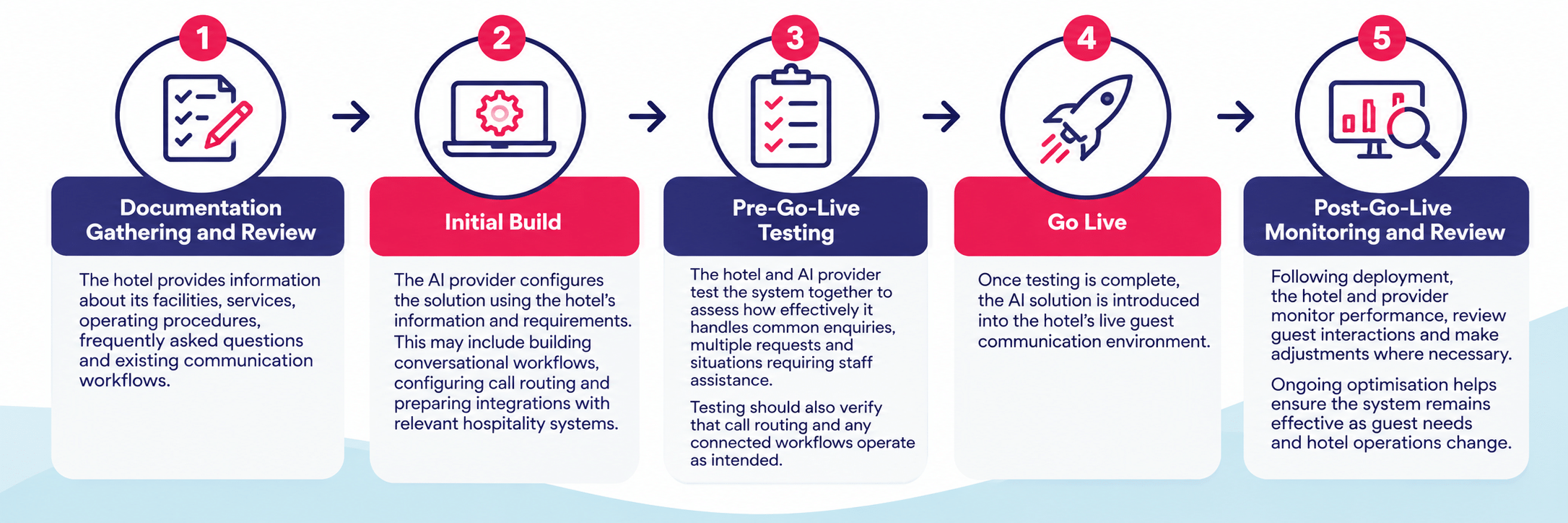
Successful AI implementation requires careful planning, integration and testing to ensure the technology works effectively alongside existing hotel operations. Before deployment, hotels should review their existing systems, prepare accurate information about their services and facilities, and identify any integration requirements.
A typical hotel AI implementation process involves several stages.
How can hotels measure AI performance?
Measuring the success of hotel AI involves more than tracking the number of calls answered. Hotels should assess how effectively enquiries are resolved and whether the technology is improving guest experiences and operational efficiency.
| Performance Metric | What It Measures |
|---|---|
| Call resolution rate | The proportion of calls successfully handled without staff intervention. |
| Calls transferred to staff | How often enquiries require human assistance. |
| Abandoned calls | Calls that end before the guest receives the assistance they need. |
| Guest satisfaction | Feedback collected about the quality of guest interactions. |
| Recurring enquiry trends | Common questions, requests and issues raised by guests. |
Using AI analytics to improve hotel operations
Beyond measuring performance, AI analytics can provide valuable insights into hotel operations. For example, frequent complaints about room temperature or repeated questions about hotel policies may highlight areas requiring attention. By regularly reviewing these insights, hotels can use AI not only to improve guest communications but also to identify opportunities for wider operational improvements.
What support and maintenance should hotel AI providers offer?
Ongoing support and maintenance are essential to ensuring hotel AI solutions remain accurate, reliable and effective over time. Hotels should establish how information such as opening hours, facilities and services is updated, who is responsible for maintaining it and how regularly system performance is reviewed. When evaluating providers, consider the availability of technical support, regular software updates, system monitoring and procedures for managing outages or unexpected issues.
Questions to ask hotel AI providers about ongoing support:
- What technical support is available, and during which hours?
- How are service outages handled, and what fallback arrangements are available?
- Who is responsible for maintaining the AI knowledge base?
- How are inaccurate responses identified and corrected?
- What reporting is available to monitor performance and guest satisfaction?
A clear support and maintenance strategy helps hotels maintain consistent service quality as operational requirements evolve.
How should hotels calculate the ROI of AI?
When evaluating hotel AI solutions, return on investment (ROI) should consider both financial savings and wider operational benefits. Hotels should assess the total cost of ownership, including subscription fees, implementation, system integrations and ongoing maintenance, against the potential improvements in efficiency and guest service.
Financial returns should not be considered in isolation. An AI solution must also deliver its intended benefits safely, accurately and reliably. Hotels should consider the risks of incorrect information, failed requests, inappropriate automation and inadequate escalation procedures alongside the potential financial benefits.
Key factors that influence hotel AI ROI
Staff efficiency: Consider the time spent managing routine calls and repetitive enquiries, and how AI could help redirect staff resources towards other responsibilities.
Guest Experience: Evaluate improvements in response times, missed calls, enquiry resolution rates and overall guest satisfaction.
Revenue opportunities: Consider whether more effective enquiry handling could help reduce missed reservation opportunities or support additional revenue from hotel services.
Operational costs: Assess potential savings from streamlined workflows and reduced administrative workloads against the ongoing costs of operating and maintaining the AI solution.
Hotels should also request relevant case studies and customer references from prospective providers to understand how the technology performs in comparable environments.
Hotel AI in practice: Xivea AI Hospitality
Xivea AI Hospitality from 14IP is a 24/7 conversational AI virtual assistant designed to help hotels manage guest communications and replace traditional menu-based IVR experiences. Xivea understands natural speech, answers common questions, sends text messages containing directions or useful links, and intelligently routes callers to the appropriate internal destination.
Natural conversations and multiple requests
Xivea can understand multiple requests within a single sentence, such as: “Can I get a toothbrush and an extra blanket?”. Guests do not need to navigate menus or press buttons to select specific services. Xivea can also understand restaurant booking enquiries that include the requested date, time and number of guests.
Multilingual guest communication
Xivea can be deployed in 26 different languages, including English, French, Spanish, German and Italian, and can offer guests a language choice when answering calls.
SMS messaging and guest assistance
Xivea can send guests links to webpages, maps and loyalty applications. It can also recognise loyalty status, where supported by the relevant systems, and conduct customer satisfaction surveys to help hotels gather feedback about guest experiences.
Frequently Asked Questions About Hotel AI
What is hotel AI?
Hotel AI refers to artificial intelligence technologies designed to support hotel operations and guest services. AI-powered voice assistants can automatically answer guest calls, respond to common enquiries, manage requests and direct callers to the appropriate department. When integrated with existing hotel systems, AI can also help automate tasks such as housekeeping requests and reservation enquiries.
What is the difference between traditional IVR and conversational AI?
Traditional Interactive Voice Response (IVR) systems typically require callers to navigate predefined menus or select numbered options. Conversational AI uses Natural Language Processing (NLP) and other AI technologies to understand everyday speech, allowing hotel guests to explain their requests naturally without following complicated telephone menus.
How can AI improve the guest experience in hotels?
AI can improve the hotel guest experience by providing immediate assistance, reducing waiting times and making hotel information available 24/7. AI voice assistants can answer common questions, support guest requests and provide personalised information when connected to relevant hotel systems. This also allows hotel staff to spend more time assisting guests with complex or sensitive enquiries.
Can hotel AI integrate with existing hotel systems?
Yes. Hotel AI solutions can integrate with existing hospitality technology, including Property Management Systems (PMS), PBX telephone systems, guest request platforms and restaurant or spa booking systems. Depending on the integration, AI may be able to access reservation information, route calls, create housekeeping tasks or support booking enquiries. The functionality available varies between providers and integrations.
What should hotels look for in an AI voice assistant?
Hotels should evaluate an AI voice assistant’s natural language understanding, ability to manage multiple requests, multilingual capabilities, hospitality integrations and human escalation procedures. Other important considerations include data security, scalability, implementation requirements, ongoing technical support and performance reporting.
Is hotel AI suitable for independent hotels and large hotel groups?
Hotel AI can support both independent hotels and multi-property hotel groups. Independent properties may benefit from automating routine enquiries and improving guest response times, while larger hotel groups may require centralised management, consistent reporting and the ability to customise AI interactions across multiple locations.
How much does hotel AI cost?
The cost of hotel AI depends on the provider, property requirements, implementation complexity, integrations and ongoing support arrangements. Hotels should consider the total cost of ownership, including subscription fees, initial setup, system integrations and maintenance, rather than comparing subscription prices alone.
How can hotels measure the ROI of AI?
Hotels can measure the return on investment (ROI) of AI by comparing implementation and ongoing costs against improvements in operational efficiency, guest experience and commercial performance. Key metrics include call resolution rates, missed calls, staff time redirected from repetitive tasks, guest satisfaction and potential revenue opportunities from more effective enquiry handling.
Connect your hotel systems with Xivea AI Hospitality
Choosing the right AI solution requires an understanding of both the technology and the operational requirements of your hotel. Whether you’re introducing AI for the first time or reviewing existing guest communication technology, 14IP is here to help.
Speak to our hospitality AI specialists to explore AI options available for your property.
Or download the complete Hotel AI Buyer’s Guide as a free PDF to share with your team.